
atlas
a marketplace that connects brands with digital advertising screens.
a marketplace that connects brands with digital advertising screens.
ROLE
Product Designer
SCOPE
Product Strategy · UX
TEAM
Founder, Developers
DURATION
6 weeks
Project overview
Project overview
Atlas is a graduation project focused on redesigning the Digital Out-of-Home (DOOH) advertising experience through a two-sided marketplace. As the sole product designer, I led the project from research to execution, designing an end-to-end platform that enables advertisers to discover and plan campaigns while helping screen owners manage and monetize advertising inventory.
Atlas is a graduation project focused on redesigning the Digital Out-of-Home (DOOH) advertising experience through a two-sided marketplace. As the sole product designer, I led the project from research to execution, designing an end-to-end platform that enables advertisers to discover and plan campaigns while helping screen owners manage and monetize advertising inventory.

"As digital advertising screens became more prevalent across physical spaces, there was no centralised way to discover and book available inventory. Campaign planning relied on spreadsheets, emails, phone calls, and manual coordination, making the process fragmented and difficult to scale."
"As digital advertising screens became more prevalent across physical spaces, there was no centralised way to discover and book available inventory. Campaign planning relied on spreadsheets, emails, phone calls, and manual coordination, making the process fragmented and difficult to scale."

Research
Validating the problem
Validating the problem
To understand how campaigns were planned in practice, I interviewed stakeholders across the advertising lifecycle, observed existing workflows, and analyzed inventory management processes. The research focused on uncovering recurring behaviors rather than isolated usability issues.
To understand how campaigns were planned in practice, I interviewed stakeholders across the advertising lifecycle, observed existing workflows, and analyzed inventory management processes. The research focused on uncovering recurring behaviors rather than isolated usability issues.

Research
Understanding the existing Marketplace
Understanding the existing Marketplace
Campaign planning began with dense inventory spreadsheets that contained extensive data but offered little support for comparing, evaluating, or selecting the right screens.
Campaign planning began with dense inventory spreadsheets that contained extensive data but offered little support for comparing, evaluating, or selecting the right screens.


Dense Inventory Data
Large inventory datasets made comparison and evaluation difficult at scale.

Limited Context
Rows of data lacked the visual and geographical context needed for confident decision-making.

Manual Evaluation
Advertisers manually filtered, interpreted, and shortlisted inventory before planning a campaign.

Fragmented Decision-Making
Additional information had to be gathered from multiple external sources before a booking could be made.
Dense Inventory Data
Large inventory datasets made comparison and evaluation difficult at scale.
Limited Context
Rows of data lacked the visual and geographical context needed for confident decision-making.
Manual Evaluation
Advertisers manually filtered, interpreted, and shortlisted inventory before planning a campaign.
Fragmented Decision-Making
Additional information had to be gathered from multiple external sources before a booking could be made.
Dense Inventory Data
Large inventory datasets made comparison and evaluation difficult at scale.
Limited Context
Rows of data lacked the visual and geographical context needed for confident decision-making.
Manual Evaluation
Advertisers manually filtered, interpreted, and shortlisted inventory before planning a campaign.
Fragmented Decision-Making
Additional information had to be gathered from multiple external sources before a booking could be made.
Synthesis
Understanding the existing Marketplace
Understanding the existing Marketplace
Analysing existing workflows revealed recurring patterns that highlighted opportunities to rethink how digital advertising inventory could be discovered and planned.
Analysing existing workflows revealed recurring patterns that highlighted opportunities to rethink how digital advertising inventory could be discovered and planned.
Observation
Observation
Insight
Insight
Opportunity
Opportunity


Ideation
Reframing the Experience
Reframing the Experience
The research revealed that improving individual steps wouldn't solve the problem. What was needed was a connected platform that simplified how inventory was discovered, evaluated, planned, and managed across the entire campaign journey.
The research revealed that improving individual steps wouldn't solve the problem. What was needed was a connected platform that simplified how inventory was discovered, evaluated, planned, and managed across the entire campaign journey.

Discovery
Why?
Finding suitable inventory depended on manual exploration.
How?
Map-based discovery replaced spreadsheet browsing with location-first exploration.
Discovery
Why?
Finding suitable inventory depended on manual exploration.
How?
Map-based discovery replaced spreadsheet browsing with location-first exploration.

Planning
Why?
Campaign setup involved repeated context switching.
How?
Created a connected workflow for configuring and launching campaigns.
Planning
Why?
Campaign setup involved repeated context switching.
How?
Created a connected workflow for configuring and launching campaigns.

Evaluation
Why?
Critical information was scattered across multiple tools.
How?
Unified inventory details into a single comparison experience.
Evaluation
Why?
Critical information was scattered across multiple tools.
How?
Unified inventory details into a single comparison experience.

Monitoring
Why?
Advertisers lacked visibility after submitting campaigns.
How?
Introduced dashboards and reporting for campaign tracking and verification.
Monitoring
Why?
Advertisers lacked visibility after submitting campaigns.
How?
Introduced dashboards and reporting for campaign tracking and verification.
Solution- Demand side
Introducing the platform
Introducing the platform
Before entering the marketplace, users are introduced to Atlas through a responsive landing page that communicates the platform, its purpose, and the value it creates.
Before entering the marketplace, users are introduced to Atlas through a responsive landing page that communicates the platform, its purpose, and the value it creates.
Helping users understand the platform before interacting with the product.
Helping users understand the platform before interacting with the product.
Discover Inventory
Discover Inventory
Replaced spreadsheet-based browsing with a map-first experience that helps advertisers discover relevant inventory based on location.
Replaced spreadsheet-based browsing with a map-first experience that helps advertisers discover relevant inventory based on location.
Discovery shifted from searching through data to exploring locations.
Discovery shifted from searching through data to exploring locations.
Evaluate Inventory
Evaluate Inventory
Brought screen details, audience insights, pricing, availability, and campaign actions into a single view, enabling advertisers to evaluate, compare, and shortlist inventory without switching between multiple screens.
Brought screen details, audience insights, pricing, availability, and campaign actions into a single view, enabling advertisers to evaluate, compare, and shortlist inventory without switching between multiple screens.

Everything needed to compare inventory was available in one place.
Everything needed to compare inventory was available in one place.
Plan Campaign
Plan Campaign
Designed a guided campaign flow that reduced context switching while keeping essential information visible throughout the process.
Designed a guided campaign flow that reduced context switching while keeping essential information visible throughout the process.
Campaign planning became a continuous flow instead of a fragmented process.
Campaign planning became a continuous flow instead of a fragmented process.
Monitor Campaigns
Monitor Campaigns
Designed a reporting experience that provides visibility into campaign progress, playback verification, and performance.
Designed a reporting experience that provides visibility into campaign progress, playback verification, and performance.
Advertisers could track campaign progress without relying on manual updates.
Advertisers could track campaign progress without relying on manual updates.
Solution- Supply side
Enabling Screen Owners
Enabling Screen Owners
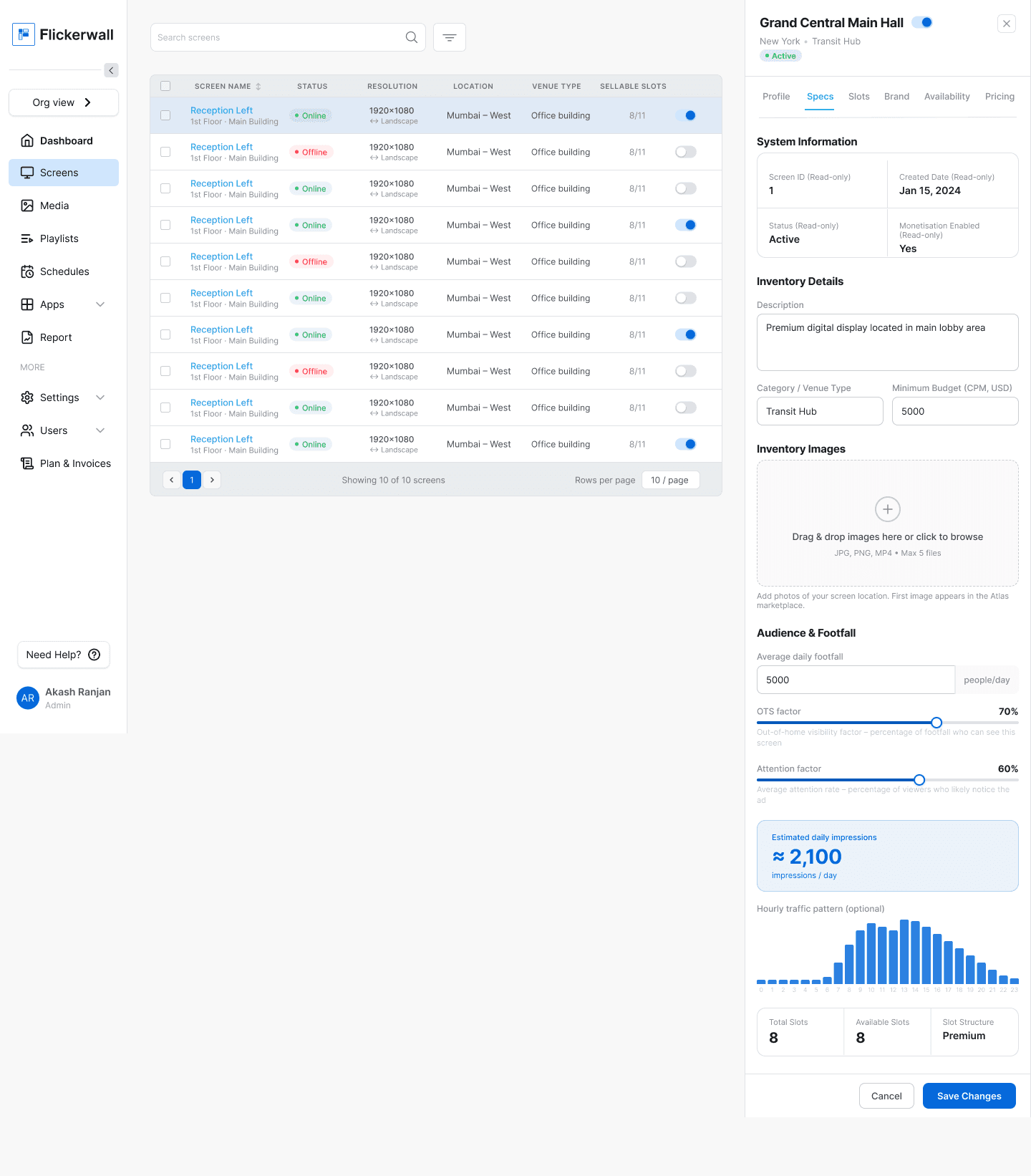
To make the marketplace viable, screen owners needed a simple way to publish inventory, define availability, and manage participation without disrupting their existing CMS workflows.
To make the marketplace viable, screen owners needed a simple way to publish inventory, define availability, and manage participation without disrupting their existing CMS workflows.



Conclusion
Reflection
Reflection
Atlas changed the way I approach product decisions. Rather than optimizing individual screens, I found myself constantly balancing user needs with technical constraints, business priorities, and marketplace dynamics. Working alongside founders, developers, and the growth team showed me that successful products are shaped through collaboration as much as design. While the project established a strong product direction, I see usability testing as the missing piece, an opportunity to validate assumptions, uncover usability gaps, and strengthen the product through real user feedback.
Atlas changed the way I approach product decisions. Rather than optimizing individual screens, I found myself constantly balancing user needs with technical constraints, business priorities, and marketplace dynamics. Working alongside founders, developers, and the growth team showed me that successful products are shaped through collaboration as much as design. While the project established a strong product direction, I see usability testing as the missing piece, an opportunity to validate assumptions, uncover usability gaps, and strengthen the product through real user feedback.