
Flickerwall Revamp
Flickerwall Revamp
Redesigned key product experiences across the user journey—from acquisition to retention—to simplify content operations and campaign management.
Redesigned key product experiences across the user journey—from acquisition to retention—to simplify content operations and campaign management.
ROLE
Product Designer
SCOPE
Product Strategy · UX
TEAM
Founder, Developers
DURATION
8 weeks
Project overview
Project overview
During my internship at Flickerwall, I redesigned key parts of the product to address low trial conversion and a fragmented user experience. The website lacked essential product information, while onboarding had significant drop-offs and failed to guide users to activation. I redesigned the website, onboarding, and core CMS workflows. After parts of the redesign went live, organic clicks increased 3x, CTR rose from 0.9% to 5.6%, and completed trials increased 20× within three months.
During my internship at Flickerwall, I redesigned key parts of the product to address low trial conversion and a fragmented user experience. The website lacked essential product information, while onboarding had significant drop-offs and failed to guide users to activation. I redesigned the website, onboarding, and core CMS workflows. After parts of the redesign went live, organic clicks increased 3x, CTR rose from 0.9% to 5.6%, and completed trials increased 20× within three months.

About Flickerwall
About Flickerwall
Flickerwall is a cloud-based digital signage platform that enables businesses to remotely manage, schedule, and publish content across digital screens through a centralized CMS.
Flickerwall is a cloud-based digital signage platform that enables businesses to remotely manage, schedule, and publish content across digital screens through a centralized CMS.
Product
Product
Content Management System (CMS) for digital screen networks.
Content Management System (CMS) for digital screen networks.
Customers
Customers
Retail chains, restaurants, gyms, corporate offices, educational institutions, and other businesses managing digital displays.
Retail chains, restaurants, gyms, corporate offices, educational institutions, and other businesses managing digital displays.
Core use case
Core use case
Managing and publishing content remotely across distributed screen networks.
Managing and publishing content remotely across distributed screen networks.

Project scope
Project scope
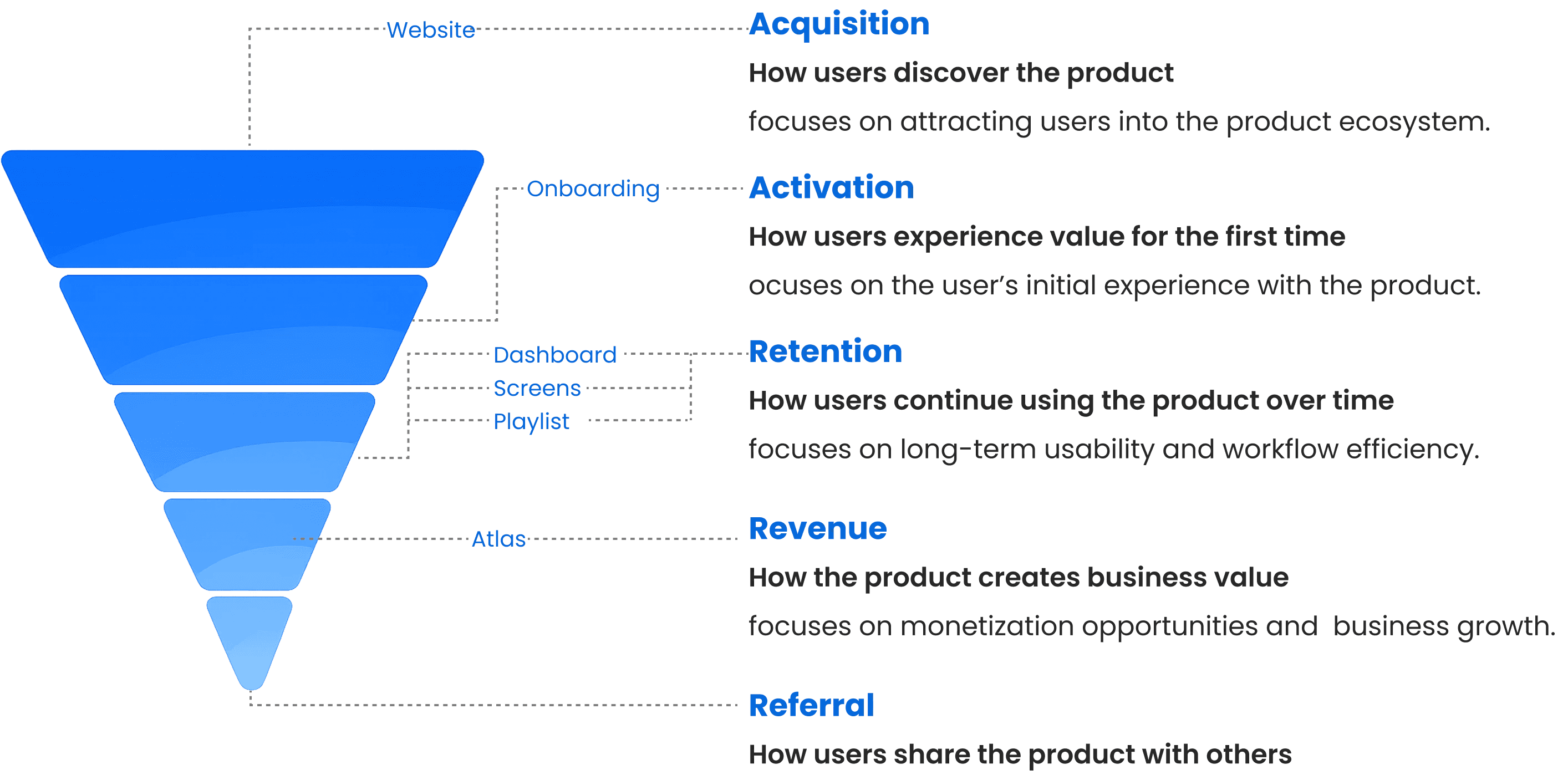
As the sole product designer, my work spanned three stages of the AARRR framework, focusing on user acquisition, activation, and retention across the product ecosystem.
As the sole product designer, my work spanned three stages of the AARRR framework, focusing on user acquisition, activation, and retention across the product ecosystem.
Foundation
Design system
Design system
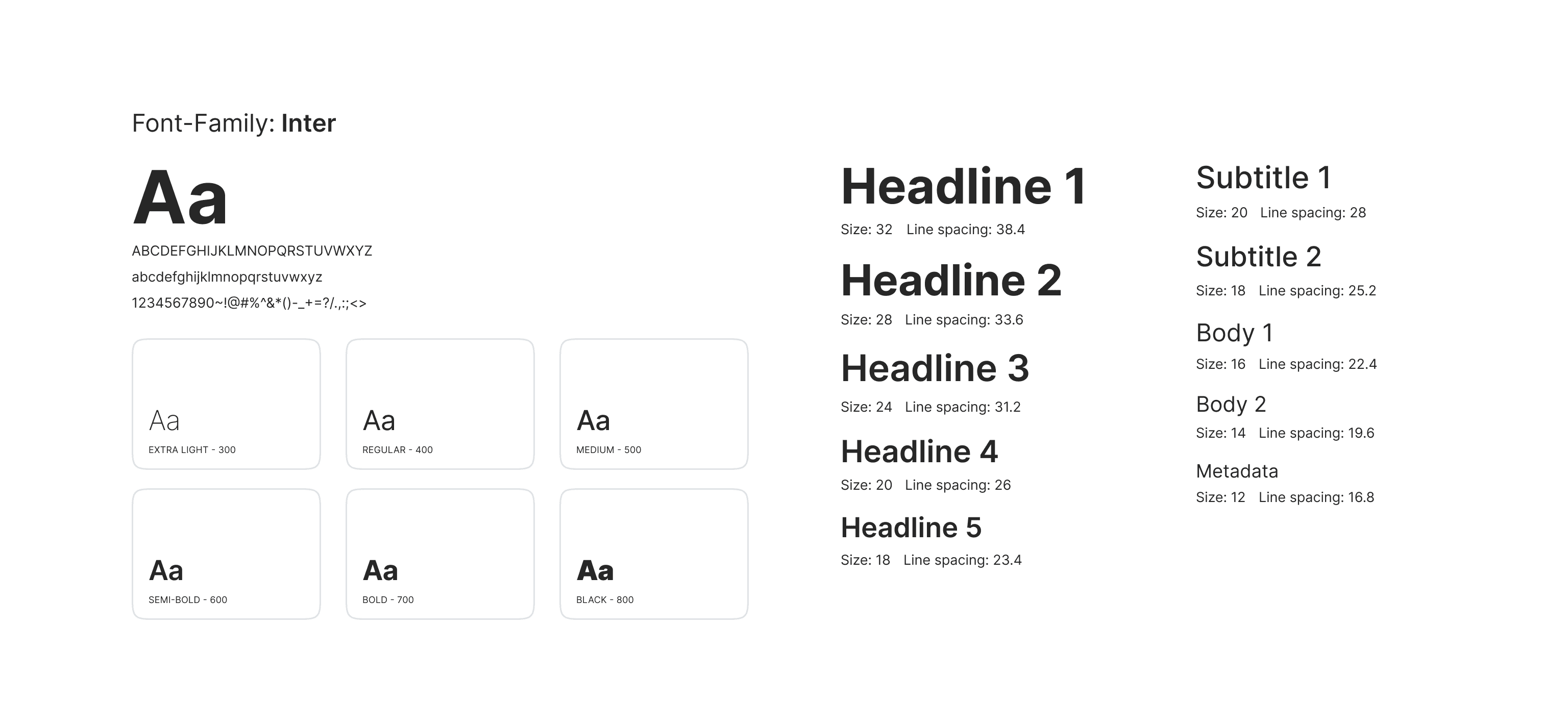
To ensure consistency across the redesigned product, I developed a scalable design system within Flickerwall's existing brand language, defining reusable components, typography, spacing, colors, and interaction patterns.
To ensure consistency across the redesigned product, I developed a scalable design system within Flickerwall's existing brand language, defining reusable components, typography, spacing, colors, and interaction patterns.



Research
Understanding the Users
Understanding the Users
To understand how users interacted with digital signage systems, I interviewed existing and potential CMS users to uncover recurring workflows, operational challenges, and decision-making patterns.
Below are few of the user statements.
To understand how users interacted with digital signage systems, I interviewed existing and potential CMS users to uncover recurring workflows, operational challenges, and decision-making patterns.
Below are few of the user statements.

Who are we designing for?
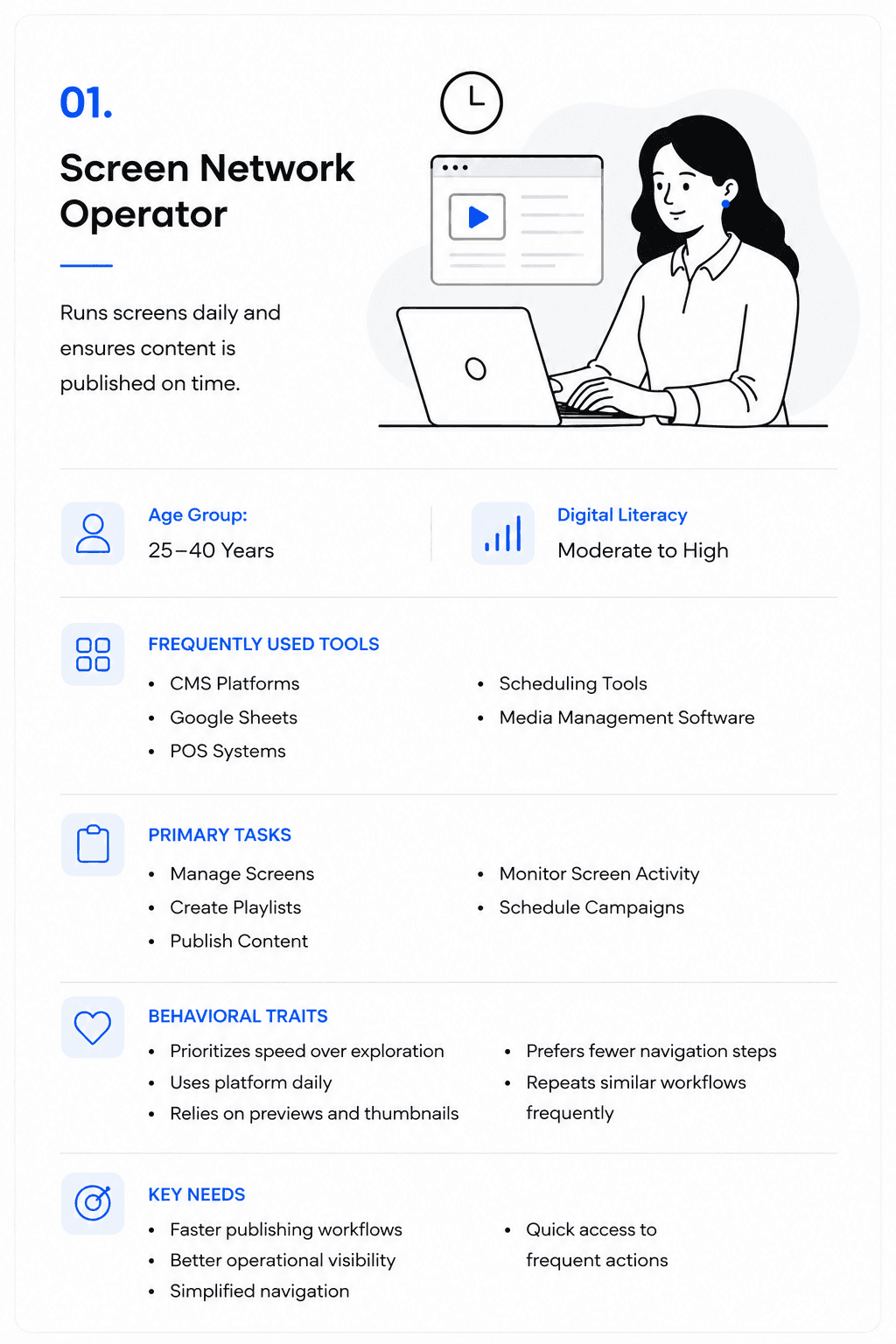
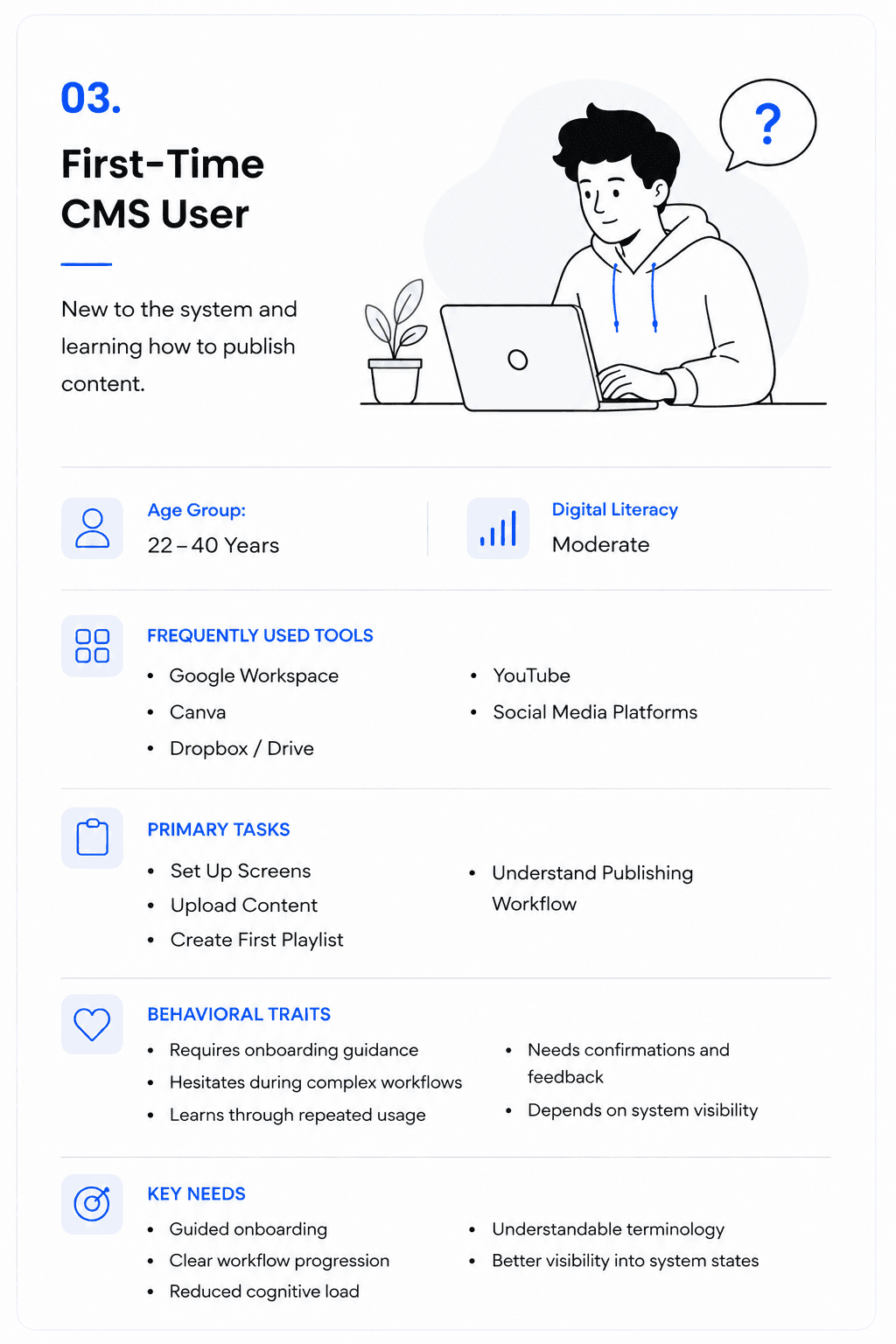
Flickerwall is used by different business roles, each with distinct responsibilities but a common goal is efficiently managing digital screen networks. Hence, I came up with user archetypes to better understand the users.
Flickerwall is used by different business roles, each with distinct responsibilities but a common goal is efficiently managing digital screen networks. Hence, I came up with user archetypes to better understand the users.

Acquisition
Website Revamp
The website is the first touchpoint for potential customers, but low engagement with key actions and limited progression through the product funnel indicated that it wasn't effectively communicating Flickerwall's value.
The redesign focused on improving product communication, strengthening conversion pathways, and helping users understand the platform faster.
The website is the first touchpoint for potential customers, but low engagement with key actions and limited progression through the product funnel indicated that it wasn't effectively communicating Flickerwall's value.
The redesign focused on improving product communication, strengthening conversion pathways, and helping users understand the platform faster.


The redesign
The redesign
Based on the evaluation, the redesign focused on improving product communication, strengthening visual hierarchy, and guiding users toward clearer conversion pathways.
Based on the evaluation, the redesign focused on improving product communication, strengthening visual hierarchy, and guiding users toward clearer conversion pathways.
A cleaner information hierarchy, stronger product communication, and a more guided conversion experience.
A cleaner information hierarchy, stronger product communication, and a more guided conversion experience.
Activation
Onboarding experience
Onboarding experience
Data revealed significant user drop-offs during onboarding, with users struggling to complete setup and reach activation. The redesign focused on reducing friction and helping users experience product value sooner.
Data revealed significant user drop-offs during onboarding, with users struggling to complete setup and reach activation. The redesign focused on reducing friction and helping users experience product value sooner.
Mapping the flow revealed long setup progression, multiple dependencies, and several interruption points before users could experience the product.
Mapping the flow revealed long setup progression, multiple dependencies, and several interruption points before users could experience the product.
Redesign
Redesign
The onboarding flow was restructured around a single objective—helping users get content live on a screen as quickly and clearly as possible.
The onboarding flow was restructured around a single objective—helping users get content live on a screen as quickly and clearly as possible.
The redesigned flow transformed onboarding from a complex setup process into a guided path toward activation.
The redesigned flow transformed onboarding from a complex setup process into a guided path toward activation.
Retention
CMS experience redesign
CMS experience redesign
Retaining users goes beyond acquisition and activation. It depends on how efficiently they can perform everyday tasks. My focus was on redesigning high-frequency CMS workflows to simplify content management, improve operational visibility, and reduce repetitive actions.
Retaining users goes beyond acquisition and activation. It depends on how efficiently they can perform everyday tasks. My focus was on redesigning high-frequency CMS workflows to simplify content management, improve operational visibility, and reduce repetitive actions.
Dashboard
Dashboard
The dashboard is the first screen users encounter after logging in and serves as the central workspace for managing day-to-day operations. The redesign focused on improving visibility, reducing repetitive navigation, and surfacing high-frequency actions.
The dashboard is the first screen users encounter after logging in and serves as the central workspace for managing day-to-day operations. The redesign focused on improving visibility, reducing repetitive navigation, and surfacing high-frequency actions.
Existing experience
Existing experience


Returning users prioritized task completion over information consumption, indicating the need for a more action-oriented dashboard.
Returning users prioritized task completion over information consumption, indicating the need for a more action-oriented dashboard.
Redesigned module


Screens Module
Screens Module
The Screens module enables users to monitor displays, assign content, and manage playback across multiple screens. The redesign focused on improving visibility, reducing navigation, and making frequent actions easier to access.
The Screens module enables users to monitor displays, assign content, and manage playback across multiple screens. The redesign focused on improving visibility, reducing navigation, and making frequent actions easier to access.
Existing experience


Behavioural insights
Behavioral analysis revealed that users prioritized monitoring screen status and accessing operational controls over secondary management tasks.
Behavioral analysis revealed that users prioritized monitoring screen status and accessing operational controls over secondary management tasks.

Redesigned module
Behavioral analysis revealed that users prioritized monitoring screen status and accessing operational controls over secondary management tasks.
Behavioral analysis revealed that users prioritized monitoring screen status and accessing operational controls over secondary management tasks.


The redesigned module consolidates critical information and frequently used actions into a more efficient screen management experience.
The redesigned module consolidates critical information and frequently used actions into a more efficient screen management experience.
Playlists Module
Playlists Module
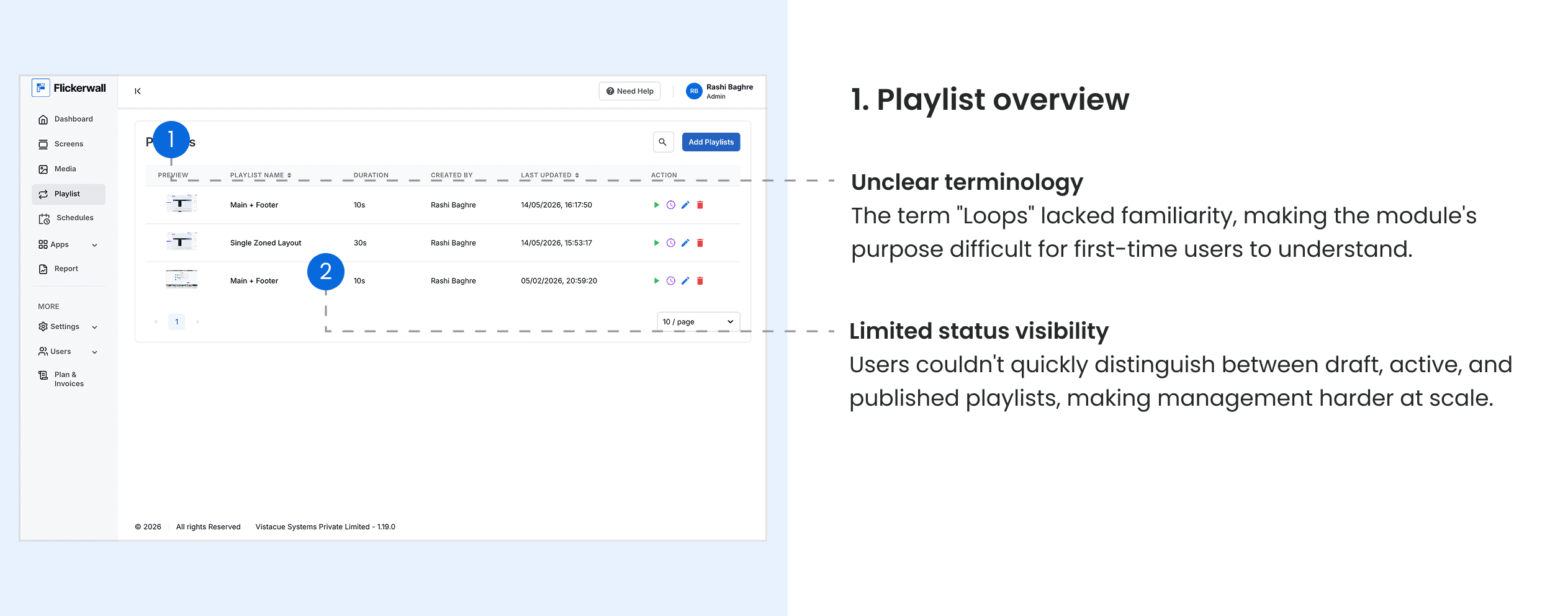
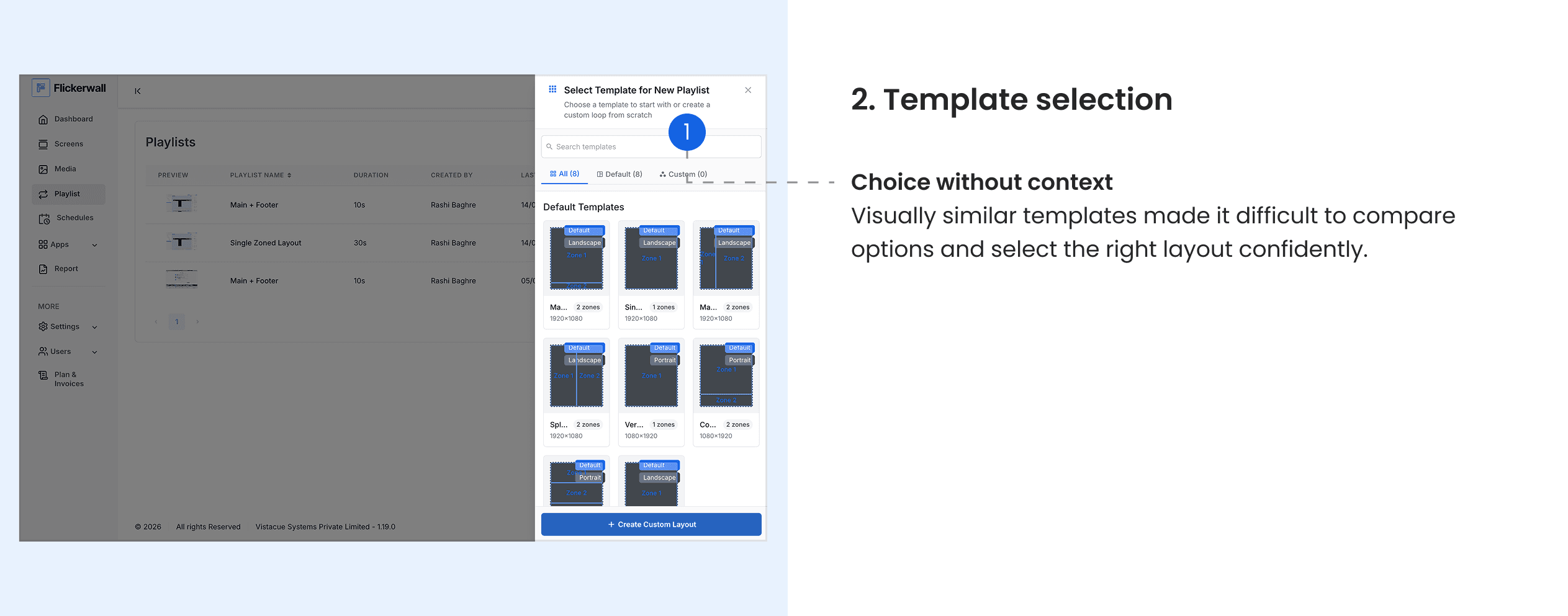
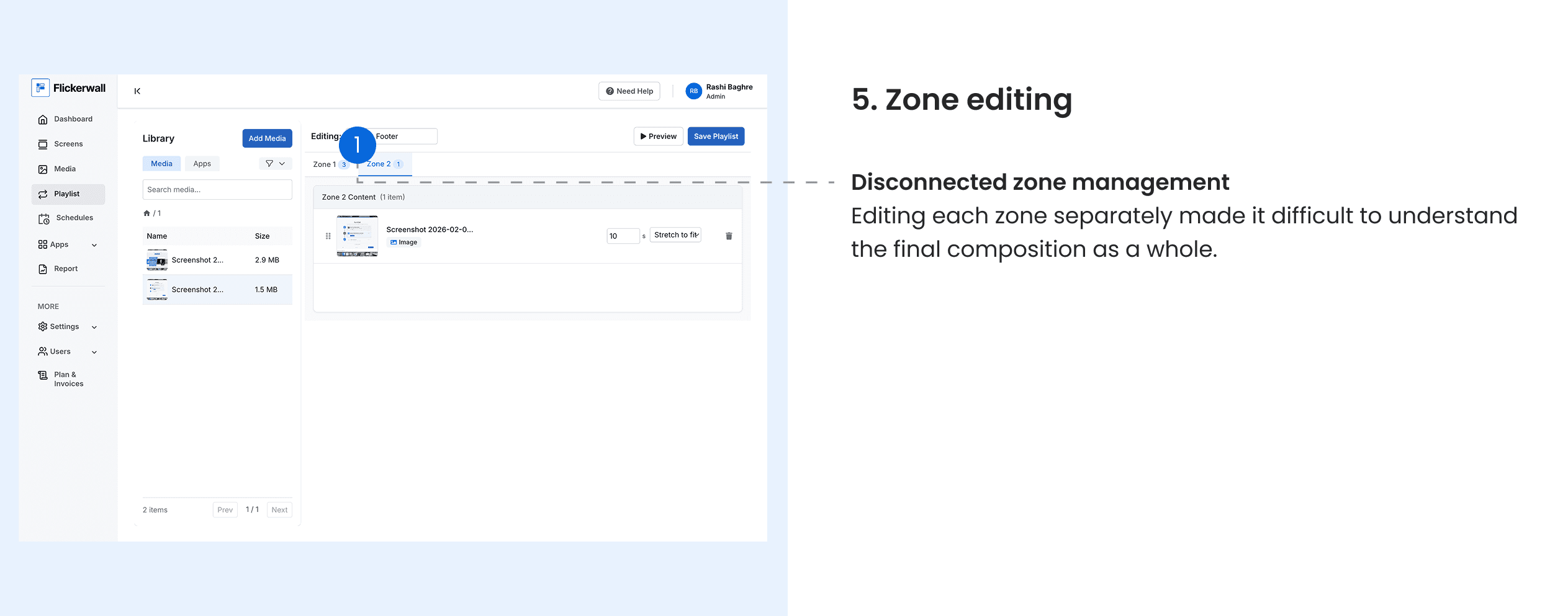
The Playlist module enables users to organize, schedule, and publish media across digital signage screens. The redesign focused on simplifying content publishing, improving terminology, and reducing workflow complexity.
The Playlist module enables users to organize, schedule, and publish media across digital signage screens. The redesign focused on simplifying content publishing, improving terminology, and reducing workflow complexity.
Behavioural analysis
Behavioural analysis
Behavioral analysis revealed that users prioritized monitoring screen status and accessing operational controls over secondary management tasks.
Behavioral analysis revealed that users prioritized monitoring screen status and accessing operational controls over secondary management tasks.





Final Experience
Behavioral analysis revealed that users prioritized monitoring screen status and accessing operational controls over secondary management tasks.
Behavioral analysis revealed that users prioritized monitoring screen status and accessing operational controls over secondary management tasks.
The redesigned module transforms playlist creation into a faster and more intuitive publishing experience, enabling users to manage content with greater clarity and confidence.
The redesigned module transforms playlist creation into a faster and more intuitive publishing experience, enabling users to manage content with greater clarity and confidence.
Reflection
Reflection
Learnings
Learnings
Behavioral analysis revealed that users prioritized monitoring screen status and accessing operational controls over secondary management tasks.
Behavioral analysis revealed that users prioritized monitoring screen status and accessing operational controls over secondary management tasks.
Key Challenges
Key Challenges
Working within an existing product meant respecting established brand guidelines, technical constraints, and legacy workflows. Building a design system while improving complex experiences without disrupting existing users was the biggest challenge.
Working within an existing product meant respecting established brand guidelines, technical constraints, and legacy workflows. Building a design system while improving complex experiences without disrupting existing users was the biggest challenge.
Looking Ahead
Looking Ahead
The product continues to evolve through usability testing, product analytics, and user feedback. Future iterations will focus on validating these design decisions and continuously refining the experience.